The End of Germany’s Delustion
It took a pandemic and the threat of war to get Germany to dispense with the two taboos – against debt and monetary financing of budgets – that have strangled its governments for decades. Now, it must join the rest of Europe in offering a positive vision of self-sufficiency and an “anti-fascist economic policy.”
Read more at PS
Crisis in the Eurozone
11 March 2025
Europe’s common currency, the Euro, is entering its second quarter century. The European Central Bank is firmly established as the #2 central bank in the world. It has survived years of turbulence. For now, debt markets are stable and the politics of Europe’s common currency are quiet. Can this last?
Europe faces huge challenges. Its economy is sluggish. Europe fears falling behind in the global tech race. It faces new security threats. Trans-Atlantic relations have been thrown into turmoil by the reelection of Donald Trump. On the horizon looms the challenge of the energy transition. This panel will explore the challenges facing the Euro area and the prospects for its future development.
The New Washington Consensus
For decades, we have been told that government-operated businesses are bad for the economy. A staple of the “Washington Consensus” that emerged in the 1980s was that “private industry is managed more efficiently than state enterprises,” because the threat of bankruptcy keeps managers in private companies focused on the bottom line. Originally formulated for countries in Latin America and then applied during the post-communist transition in Central and Eastern Europe, the Washington Consensus has been the dominant economic policy paradigm ever since.

“Les idées larges”
May 2025
Laura Raim interviews Katharina Pistor for the ARTE series “Les idées larges” (Big Ideas) about the Code of Capital and its application to data (in French and German).
“42: The Answer to Almost Everything”
February 23, 2025
Katharina Pistor is featured in an episode about why wealth is so unfairly distributed. (In German and French with English subtitles).

Grammar of Calculated Ambiguity
Katharina Pistor participated in this video-are-project by the Swiss media-artist Gabriela Löffel, that dissects the role of professional services, including lawyers, accountants and trust advisors, in expanding the system of offshore finance and tax avoidance.
Organizing for change Towards: a new paradigm for meat governance
Wednesday, January 15, 2025. 8:00 PM 9:30 PM
Our meat production focuses on profit at any price – ecological and social costs are neglected. Katharina Pistor argues for an alternative system: ‘Organizing for change’. Animals should no longer be regarded merely as capital, but should be at the center of a system that protects the earth and regenerates resources.
The Laws of Capitalism: Trailer
Introduction to the Laws of Capitalism series at New Economic Thinking (INET).
In this series, Professor Katharina Pistor (@ColumbiaLawSchool1) breaks down the history, process, institutions, and participants involved in the legal coding of capital. She shows us how private actors have harnessed social resources to accumulate wealth, generating not only economic inequality, but inequality in law. Enabling them to opt out of jurisdictions, restrict governmental policy, and erode democracy.

INET Videos: Coding Capital – An Animation
Katharina Pistor explains how our legal system is manipulated to protect wealth, and why the rules of the game always seem just out of reach.
Produced by Matthew Kulvicki & Nick Alpha
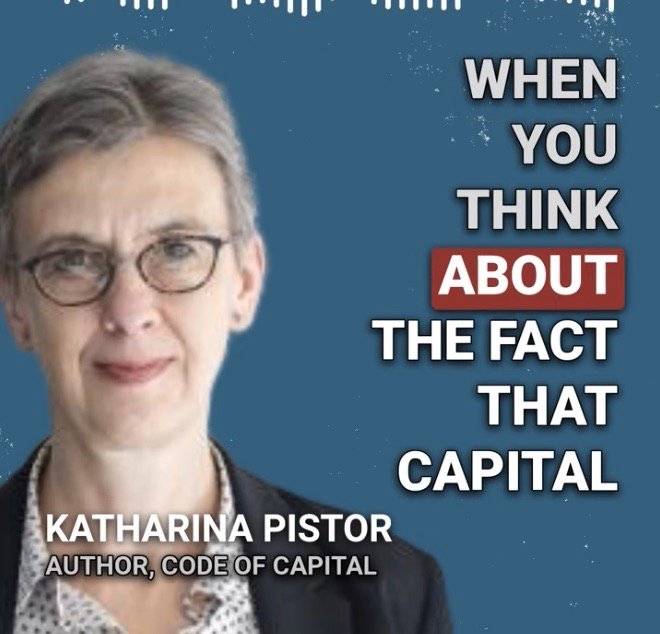

The Break Down: The Invisible Code of Capitalism.
Capitalism could not exist without the power and structure of the law — that’s the simple but radical argument made by my guest today, Katharina Pistor, law professor at Columbia University, and the author of The Code of Capital: How The Law Creates Wealth and Inequality.
Ezra Klein Show: A Guide to the ‘Legal Fictions’ that create Wealth, Inequality, and Economic Crises.
This is a conversation that delves into the deepest layer of our economic system — one that shapes all of our lives even as it remains largely invisible. We discuss the four legal attributes that transform an ordinary asset into a wealth-generating device, how the law creates corporations and financial instruments out of thin air, the “feudal calculus” that underpins our modern economy, why focusing solely on wealth redistribution will never be sufficient to solve economic inequality, how private lawyers — operating outside democratic institutions — end up shaping the rules of our economic system, the “law and finance paradox” that explains why financial crises happen, how legal manipulation has eroded the “social contract” of capitalism, whether the law can work as a tool to help fight climate change and more.
To Google or Not to Google
A company that achieves its monopoly status by offering better products or services has not broken any law; but the situation changes when it willfully acquires or maintains that power. With a federal judge ruling that Google has crossed the line, the future of internet search is now an open question.
Outsourcing our Future To For-Profit AI
Recent developments suggest that policymakers and others in positions of public authority are more than happy to cede total control to the corporations commercializing artificial intelligence. Once again, the returns will remain private, but any future costs will inevitably be borne by the public.
Capitalism is Driving Democracy’s Death Spiral
The post-election blame game in the United States will not only tear apart the Democratic Party, but will also distract from the elephant in the room. Democracy has been eroded by a socioeconomic regime that puts price signals above people's needs, undermining the capacity for consensus and collective decision-making.
The Value of Law
In this article, Pistor draws attention to law’s pecuniary value. Law is the very stuff from which many wealth generating, or capital, assets are made, foremost among them intangible assets that account for most of the private wealth today. For law to serve as a fountain of wealth, it must be backed by state power, and indeed, sovereign states have been more than willing to offer a helping hand. In short, the most critical source for wealth, that is law, is itself of the state and should be subject to social norms enshrined in our constitutions, not abstract welfarism.
From Territorial to Monetary Sovereignty
In this article, Pistor argues that the relevance and importance of territorial versus monetary sovereignty has shifted in favor of the latter. This shift goes hand in hand with the rise of credit-based financial systems. Such systems depend, in the last instance, on backstopping by an entity with control over its own money supply and no binding survival constraints. Only states with monetary sovereignty fit this pattern. All others are de facto more like private entities, which by definition cannot manipulate their own survival constraint.
Rule by Data: The End of Markets?
In this paper, Pistor argues that while it may well be the case that law constitutes markets, markets are not the only way in which economic relations may be organized, and law is not the only feasible mode of governing these relations. Central planning under socialism posed an alternative, which proved ultimately non-viable.1 The rise of big tech companies (Big Tech) and their accumulation of vast amounts of data offers yet another possibility: the rule by data.

The Code of Capital
Capital is the defining feature of modern economies, yet most people have no idea where it actually comes from. What is it, exactly, that transforms mere wealth into an asset that automatically creates more wealth?
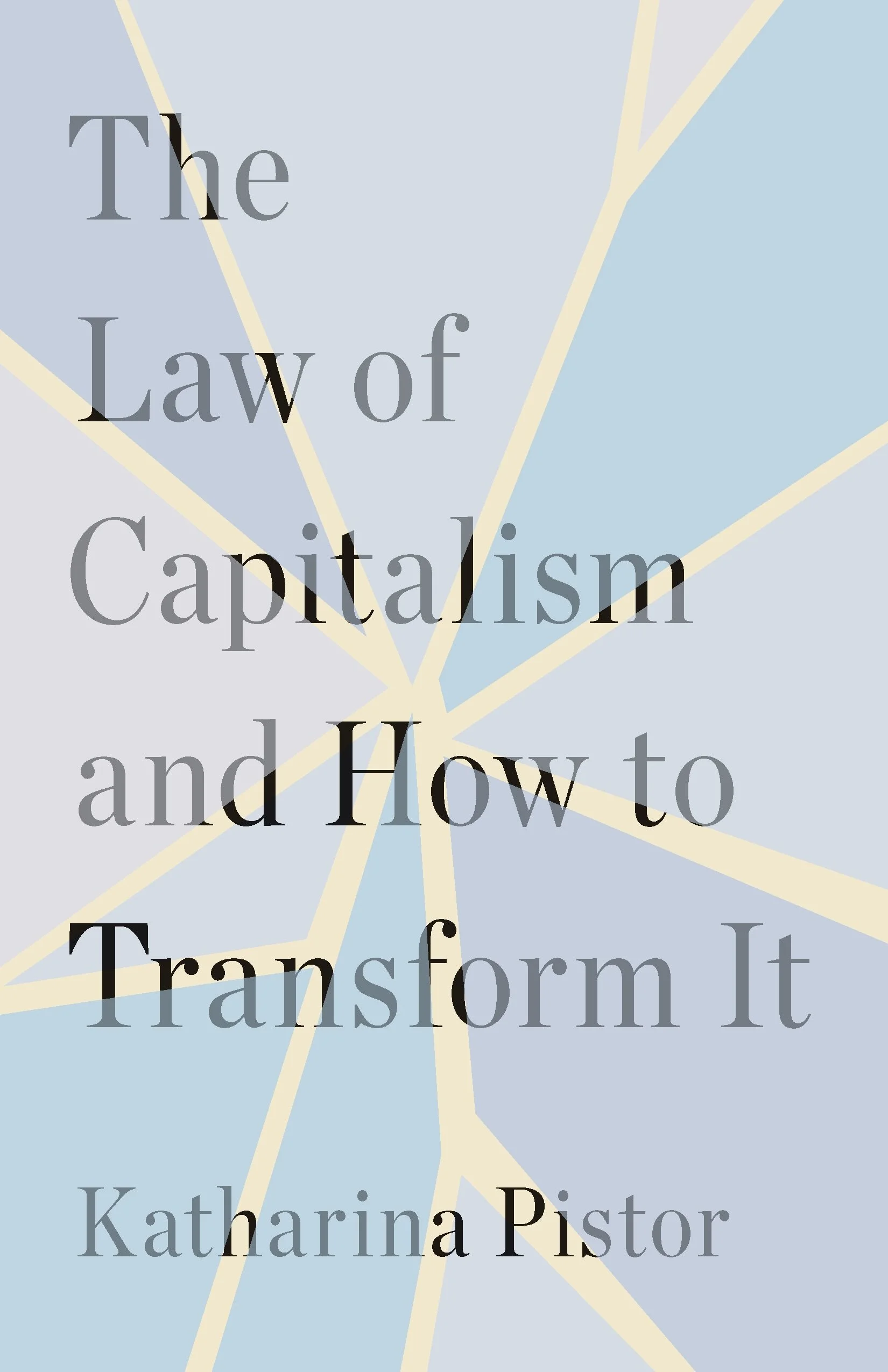
The Law of Capitalism and How To Transform It
New September 2025: A fascinating study of the legal underpinnings of capitalism, why the system must be transformed, and what we can do about it