
Events & Appearances
A discussion of “The Law of Capitalism and How to Transform It” with Anne Sanders (University of Bielefeld), moderated by Verena Madner (WU Vienna) https://www.youtube.com/@LawGovWU
April 13, 2026
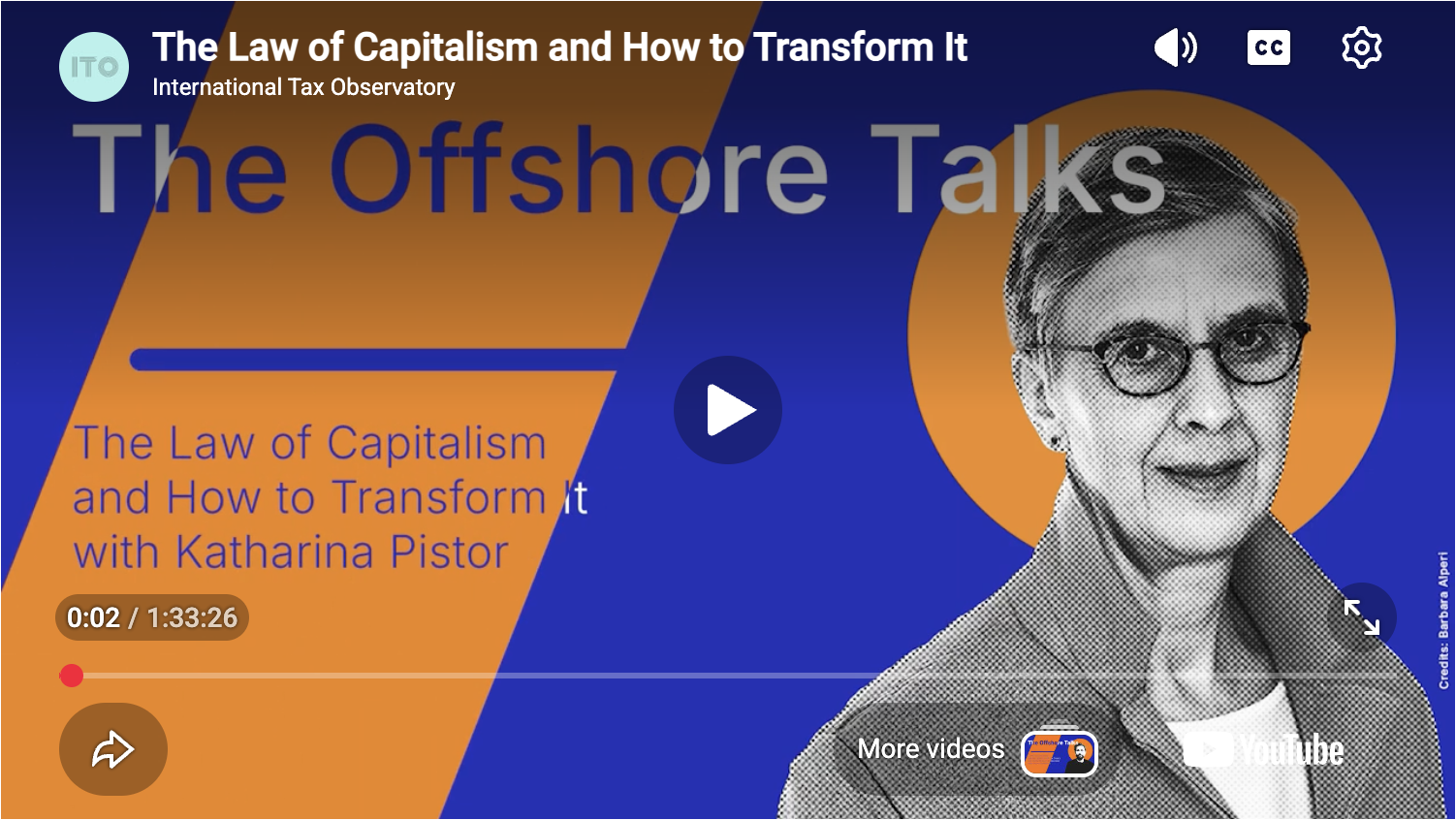
June 11, 2026
Presentation of “The Law of Capitalism” with comments by Thomas Piketty.
5-6 June, 2026
Presenation “Legal Transformations: Lessons from the Transplantation of Law in Turkey and Beyond”
Koç Univesity, Istanbul (Turkey)

The launch of Hettie O’Brien’s new book, “The Asset Class”, provided the occasion for digging deeply in the structures of capitalism and its ramifications for society.
Lectured on the legal coding of capital, capitalism as a legal regime and possible strategies for transformations
Discussed “Escaping Legal Colonialism: Lessons from South Africa and Beyond” with Steven Vogel (Berkeley) and Judge President of the SA Competition Appeal Court, Norman Manoim

Conversation with Goutham Yegappan about who really writes the rules of capitalism
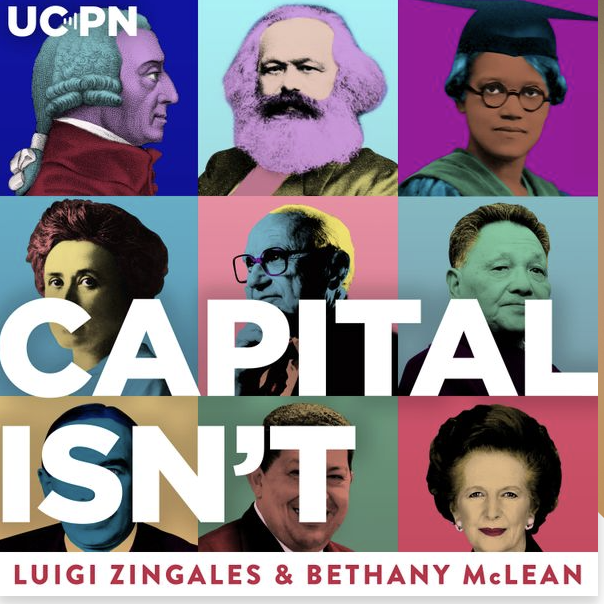
Podcast Interview with Luigi Zingales and Bethany McLean about the constitute role of law for capitalism based on “The Code of Capital” and “The Law of Capitalism and How to Transform It”, available on YouTube.
February 19, 2026


Dass wir in einer kapitalistischen Gesellschaft leben, wissen wir, weil es uns alle zwingt, irgendwie Geld zu machen. Wie aber macht man Kapital? Das ist weitaus weniger bekannt. Die bahnbrechenden Arbeiten der Rechtswissenschaftlerin Katharina Pistor zeigen, dass Kapital – also der Reichtum, der die Reichen reicher macht – durch spezifische Rechtsformen entsteht, die ständig raffinierter werden. Sie nennt das den „Code des Kapitals“. Code kennt allerdings auch Botchen und denkt dabei an Programmiersprache. Und tatsächlich fragt sich Katharina Pistor in ihrer aktuellen Forschung, ob es sein könnte, dass in Zukunft nicht so sehr Gesetze, sondern Algorithmen darüber entscheiden, wo sich Reichtum konzentriert. Wer kann da überhaupt noch mitentscheiden? Und wo bleibt Botchen, wenn die großen Sprachmodelle anfangen, an Code und Gesetzestexten mitzuschreiben?
9 Januar 2026

Was ist Ungleichheit der Vermögen, wie kommt sie zustande und welche Rolle nimmt hierbei das Recht und der Staat ein? Dies sind einige der Fragen, denen wir hier nachgegangen sind.
Erhältlich auf YouTube
28 October 2025

20 October 2025 (London)
Coding Capital can be read as a critique of capitalism and its genesis. It can also be read as an approach to comparative legal analysis with the focus on political economy.

22-24 October (Frankfurt)
Well constituted? Toward a new order for the monetary system

May 2025
Podcast mit Kathrin Fischer zum Thema “Kapitalismus auf rechtlichen Steroiden” auf Youtube und Spotify

22 April 2025
Can this system last? Are alternatives imaginable? This panel will take up one of the most basic issues in the world economy today.
9 April 2025
This cross-disciplinary panel will consider the forces that undermine the capacity of societies to find common ground for effective self-governance, especially under conditions of uncertainty and during political and economic shocks. The discussion will explore structural forces threatening shared prosperity, tradeoffs inherent in economic policymaking, pathways to a more just and inclusive economy, and the significance of a political economy fit for advancing the future of democracy.
11 March 2025
Europe’s common currency, the Euro, is entering its second quarter century. The European Central Bank is firmly established as the #2 central bank in the world. It has survived years of turbulence. For now, debt markets are stable and the politics of Europe’s common currency are quiet. Can this last?
Europe faces huge challenges. Its economy is sluggish. Europe fears falling behind in the global tech race. It faces new security threats. Trans-Atlantic relations have been thrown into turmoil by the reelection of Donald Trump. On the horizon looms the challenge of the energy transition. This panel will explore the challenges facing the Euro area and the prospects for its future development.

May 2025
Laura Raim interviews Katharina Pistor for the ARTE series “Les idées larges” (Big Ideas) about the Code of Capital and its application to data (in French and German).
February 23, 2025
Katharina Pistor is featured in an episode about why wealth is so unfairly distributed. (In German and French with English subtitles).

Katharina Pistor participated in this video-are-project by the Swiss media-artist Gabriela Löffel, that dissects the role of professional services, including lawyers, accountants and trust advisors, in expanding the system of offshore finance and tax avoidance.
Wednesday, January 15, 2025. 8:00 PM 9:30 PM
Our meat production focuses on profit at any price – ecological and social costs are neglected. Katharina Pistor argues for an alternative system: ‘Organizing for change’. Animals should no longer be regarded merely as capital, but should be at the center of a system that protects the earth and regenerates resources.
Introduction to the Laws of Capitalism series at New Economic Thinking (INET).
In this series, Professor Katharina Pistor (@ColumbiaLawSchool1) breaks down the history, process, institutions, and participants involved in the legal coding of capital. She shows us how private actors have harnessed social resources to accumulate wealth, generating not only economic inequality, but inequality in law. Enabling them to opt out of jurisdictions, restrict governmental policy, and erode democracy.
Katharina Pistor explains how our legal system is manipulated to protect wealth, and why the rules of the game always seem just out of reach.
Produced by Matthew Kulvicki & Nick Alpha
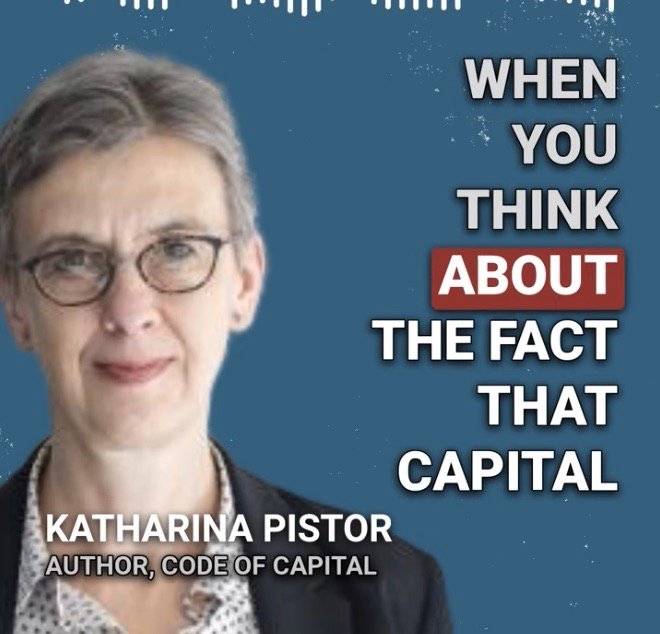
You can view this short on YouTube.
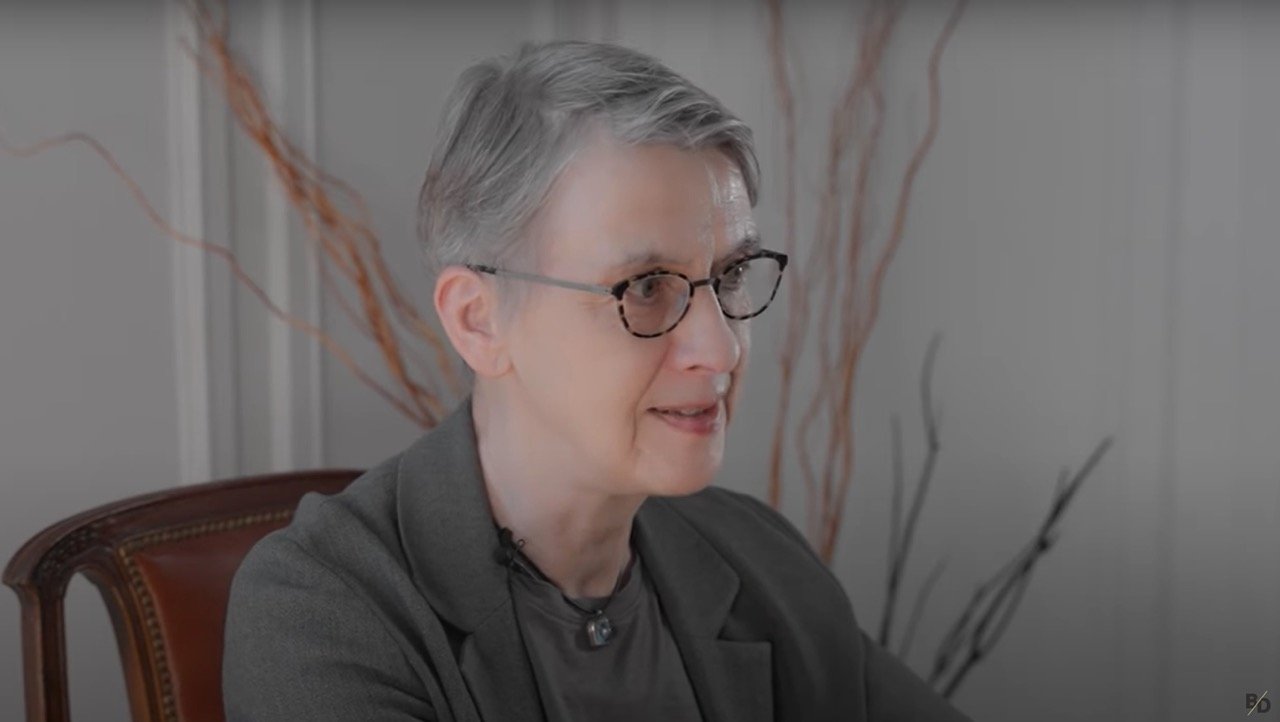
Capitalism could not exist without the power and structure of the law — that’s the simple but radical argument made by my guest today, Katharina Pistor, law professor at Columbia University, and the author of The Code of Capital: How The Law Creates Wealth and Inequality.
This is a conversation that delves into the deepest layer of our economic system — one that shapes all of our lives even as it remains largely invisible. We discuss the four legal attributes that transform an ordinary asset into a wealth-generating device, how the law creates corporations and financial instruments out of thin air, the “feudal calculus” that underpins our modern economy, why focusing solely on wealth redistribution will never be sufficient to solve economic inequality, how private lawyers — operating outside democratic institutions — end up shaping the rules of our economic system, the “law and finance paradox” that explains why financial crises happen, how legal manipulation has eroded the “social contract” of capitalism, whether the law can work as a tool to help fight climate change and more.
Tuesday, May 21, 2024
Economists discovered the firm as a serious object of inquiry only a century ago when Ronald Coase famously asked, why firms exist at all. Firms were benchmarked against markets, which gave us transaction cost economics and the incompleteness of contracts as foundations for the theory of the firm.
Monday, May 20, 2024
Finance is a critical ingredient for all enterprises. It is well established that early on most rely on family on friends, and occasionally on local banks. Scaling size and operations, however, often requires external funding in addition to retained earnings.
Friday, May 17, 2024
This is the first in a series of lectures given by Katharina Pistor for the Oxford University Faculty of Law in 2024.
Enterprises have been around for much of human history. They are formed when people join forces in pursuit of a common goal, for pooling skills and resources, diversify risk, or simply finding a way to sustain themselves and their families.
A discussion in 10 chapters, including Public and Private Law, Two Sides of Governance, The Traps of Formal Equality, The Various Levels of the Law, The Semantics of Corporations, Legal Translations of Post-Colonialism, How to Transform Capital, Constitutional Law and its Rights, The Digital Code,Green Capitalism, and Conclusion.